Stadium construction projects are growing more expensive and complex, with higher stakes than ever before. Amidst labor shortages, supply chain volatility, and financial instability stakeholders are moving forward. Do you have the right strategy, and the right partners, to place coverage on these high-profile mega-projects?
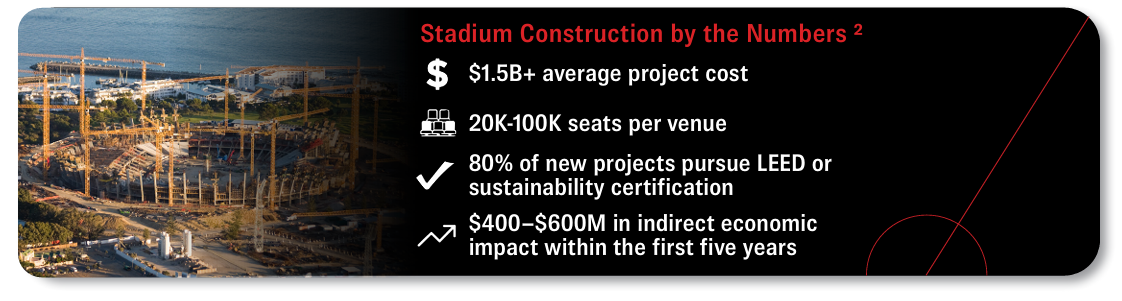
Across the country, stadium construction is experiencing a renaissance. Professional sports franchises, universities, and municipalities are investing billions into new or redeveloped venues designed to host far more than game day crowds. Today’s stadiums double as entertainment hubs, mixed-use developments, and technology-driven fan experiences. With that evolution comes a dramatically more complex insurance landscape.
For retail insurance agents, stadium construction projects represent both a tremendous opportunity and a formidable challenge. These are some of the largest and most scrutinized construction risks in the market, requiring careful coordination, specialized underwriting, and deep expertise across multiple lines of coverage.
WHY STADIUM CONSTRUCTION IS DIFFERENT
While stadium construction shares foundational elements with traditional commercial projects, it presents a distinct set of complexities that place heightened emphasis on certain critical factors. These considerations underscore the importance of partnering with a dedicated specialist who understands the unique risks, scale, and stakeholder dynamics inherent to stadium development, including:
- Unique stakeholder and investor alignment
- Extraordinary total insured values, often reaching into the billions
- Lengthy, multi-phase construction timelines that intensify schedule risk and potential revenue loss from delayed completion
- Highly specialized trades and materials
- Public visibility and political scrutiny
- Integration of advanced technology systems
These factors amplify both the frequency and severity of potential losses. A delay, design flaw, or uninsured exposure can ripple across contractors, owners, municipalities, and financiers, making risk transfer decisions critical from day one.

BUILDERS RISK AT SCALE
Builders Risk is the cornerstone of stadium construction insurance, but mega-projects challenge traditional assumptions. High-value steel, custom architectural components, and specialty installations may sit on-site for extended periods, increasing exposure to theft, weather damage, or transit loss. Long project durations also elevate the likelihood of loss events over time. Additionally, insured values often shift mid-project as material costs fluctuate or design changes occur. Without proactive monitoring and policy flexibility, these changes can leave projects underinsured or exposed to coinsurance penalties.
WRAP-UPS: OCIPS + CCIPS IN STADIUM CONSTRUCTION
Owner-Controlled and Contractor-Controlled Insurance Programs (OCIPs and CCIPs), commonly referred to as wrap-ups, play a critical role in stadium construction projects due to the scale, complexity, and number of stakeholders involved. These programs consolidate workers’ compensation, general liability, and excess liability coverage under a single coordinated structure, providing consistency across contractors and subcontractors while offering owners greater control over risk management. For stadium projects, wrap-ups offer several key advantages:
- Uniform coverage terms and limits across all enrolled parties, reducing coverage gaps and disputes between contractors
- Enhanced safety oversight and loss control, which is particularly important on high-visibility, politically scrutinized projects
- Potential cost efficiencies through economies of scale and reduced duplication of insurance
- Improved claims coordination, helping mitigate disputes that could otherwise delay construction
However, wrap-ups also introduce complexity. Enrollment protocols, deductible structures, coverage extensions, and coordination with Builders Risk, professional liability, and cyber programs must be carefully managed. Additionally, exclusions or carve-backs within wrap-up policies, such as professional services, design-build exposures, or off-site operations, can create unintended gaps if not addressed early.
Given the multi-year timelines and evolving scope typical of stadium construction, aligning the wrap-up program with other project-specific coverages is essential. Early involvement by experienced specialists helps ensure the OCIP or CCIP is structured appropriately, integrated seamlessly with the broader insurance program, and flexible enough to adapt as the project progresses.
LABOR + SUPPLY CHAIN PRESSURES
Stadium projects can strain regional labor markets, pulling skilled trades away from other construction and driving up wage costs. Specialized workers like structural steel installers, technology integrators, and advanced systems contractors are often in limited supply, increasing the risk of delays and workmanship issues.
Supply chain volatility compounds these challenges. Long lead times for materials, transportation disruptions, and global sourcing issues can all push schedules off course. For insurers, delays translate into prolonged exposure; for agents, they raise questions around policy term extensions, revised values, and coverage adequacy.
TECHNOLOGY + CYBER RISK IN MODERN VENUES
Today’s stadiums are “smart buildings,” relying on interconnected systems to manage operations, security, ticketing, concessions, and fan engagement. During construction, these systems are often installed and tested well before project completion, creating cyber exposures that fall into gray areas between traditional construction insurance and cyber liability. Retail agents and brokers must consider:
- Who is responsible if a system failure delays construction?
- How cyber incidents during installation impact builders risk or professional liability coverage
- Whether contractors and vendors meet minimum cyber hygiene standards
Failure to address these questions early can leave significant gaps in coverage.
ENVIRONMENTAL + SITE-SPECIFIC CHALLENGES
Many stadiums are built in urban cores or redeveloped industrial areas to maximize economic impact. These sites often bring environmental exposures such as soil contamination, legacy pollutants, or complex geotechnical conditions.
Environmental remediation can dramatically alter project timelines and costs, and losses may not be fully addressed by standard builders risk policies. Coordinating environmental liability coverage alongside construction insurance is essential, and often overlooked without specialist involvement.
UNDERWRITING, CAPACITY + MARKET COORDINATION
While carrier appetite for stadium construction remains strong, no insurer is willing to assume the entire risk. These projects require layered or quota-share placements involving multiple carriers, each with distinct underwriting requirements and risk tolerances. Securing an experienced lead facility, whether on Builders Risk or casualty, is integral to insurer community receptiveness and collaboration. This fragmented capacity underscores the importance of:
- Detailed underwriting submissions
- Clear articulation of risk controls and safety protocols
- Consistent communication across carrier partners
Retail agents benefit from wholesale partners who understand how to properly structure stadium construction programs and negotiate favorable terms across the market. This advantage is driven by access to benchmarking data from comparable projects to guide the deployment of appropriate limits, combined with deep carrier relationships and the scale needed to secure preferred market access and best-available pricing for each project.
WHAT RETAIL AGENTS SHOULD BE DOING NOW
- Engage specialty brokers early, before project scope and insurance requirements are finalized.
- Map exposures holistically, accounting for construction, technology, environmental, and professional risks.
- Prepare for ongoing adjustments, including value changes and policy modifications throughout the build.
- Leverage market knowledge, rather than approaching placements transactionally.
BOTTOM LINE
Stadium construction projects demand more than market access. They require experience, strategy, and collaboration. CRC Specialty stands apart as a wholesale brokerage partner by offering:
- Deep construction and specialty knowledge, tailored to mega-project risk
- Strong carrier relationships capable of supporting large, layered placements
- An integrated risk perspective, aligning the OCIP/CCIP, builders risk, professional indemnity, with cyber, and environmental considerations
- Hands-on partnership, supporting retail agents from early planning through project completion
For retail agents seeking to expand their presence in stadium and large-scale construction, CRC Specialty offers the insight, internal benchmarking resources, and market leverage that complex projects demand. Representing more than $30B in annual E&S premium, we bring the scale and credibility needed to help turn challenging stadium construction risks into successful placements. Connect with your CRC Specialty producer today to start the conversation.
CONTRIBUTORS
- Evan Aldrich is the Office President for Charleston, South Carolina and CRC Specialty’s National Construction Practice Director.
- Andrew Grim is a Senior Vice President and Casualty Broker for Dallas CRC’s National Construction Practice.
ENDNOTES
- Stadium construction boom tests insurers’ appetite for mega-project risk, Insurance Business America, December 15, 2025. https://www.insurancebusinessmag.com/us/news/construction/stadium-construction-boom-tests-insurers-appetite-for-megaproject-risk-560127.aspx
- Mega Sports Stadium Construction Projects | American Sports Infrastructure, Skillit. https://skillit.com/mega-sports-stadium-construction-projects-american-sports-infrastructure