Fewer markets are willing to bet big on large risks in an environment of rising losses, higher claims, and soaring jury verdicts. Still, they’re often willing to offer smaller limits or to participate in positions less likely to be hit by a large loss. That makes quota share deals an increasingly attractive choice for excess programs. Here’s what retailers should know.
Insurers rarely want to shoulder a significant risk on their own. To minimize exposure and protect against significant losses on a single account or across their entire portfolio, carriers seek ways to share the load. Carriers often achieve this through layered excess programs or quota share arrangements. While layered programs are common in excess property and casualty insurance, quota shares are becoming increasingly prevalent as carriers seek to limit risk amid rising claims and jury awards.
WHY IS QUOTA SHARE HELPFUL?
Quota share becomes essential when no single carrier can or will take the full exposure. With carriers reducing their deployment limits from $25 million to $10 million or $15 million, towers that would have been completed with 4 or 5 carriers now require twice that many to meet the limit requirements of the insured. Utilizing a quota share strategy allows brokers to maintain large limit stretches and the associated rate relativity up the excess tower.
HOW DOES QUOTA SHARE WORK?
A lead carrier typically sets the terms and conditions, and following markets agree to a set participation percentage.
This “true lead” construct is standard in London/Bermuda lineslips, where the lead sets terms, price, and claims handling for followers pursuant to a written claims agreement. This dynamic was born out of Lloyd’s, where underwriters often knew one another and treated the lineslip as a collaborative vehicle to support a risk.
By contrast, U.S. domestic quota shares have historically featured less centralized leadership. Carriers often prefer to maintain their own claims handling and apply their own corporate- and compliance-driven forms and terms. As a result, there is rarely a single lead carrier; each participant typically quotes its own portion and maintains control of terms and claims. Brokers then work to limit differences and close gaps so the structure functions as seamlessly as possible.

U.S. MARKET NUANCES (PROS + CONS)
In the U.S., a key upside is practical. Quota shares can help fill capacity gaps without forcing excessive vertical layering. By spreading risk, carriers allocate less capital per account and attract more participants at competitive pricing. However, without a claims agreement, disputes may slow investigation, settlement, or payment, and insolvency or coordination issues can create costly delays.
Here are a couple of simplified examples of how a quota share arrangement can work:
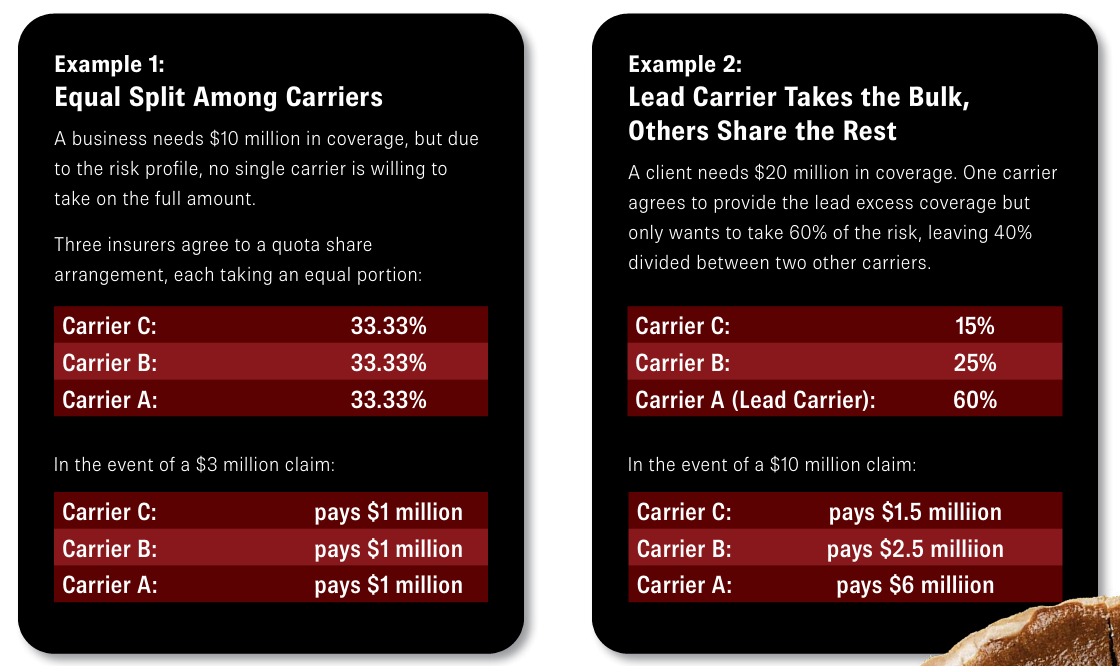
Whether lead or excess, participants ideally align on coverage, price, and claims handling. In London/Bermuda, the lineslip and claims agreement codify this. In the U.S., because each carrier may bring its own form and claims posture, alignment requires more negotiation, and the absence of a formal claims agreement can complicate the execution of claims.
It’s also why many carriers remain hesitant about quota-sharing lead excess placements; many insureds prefer a single carrier in a lead position for both underwriting and claims continuity. Without a claims agreement, resolution can bog down. Participants may disagree on investigation steps, defense strategy, settlement timing, or payment mechanics. Counterparty credit risk matters too. Insolvency of a participant can create practical shortfalls. Operationally, having more markets means more notifications, endorsements, and coordination overhead for both the insured and the broker.

In London and Bermuda, digital, data-driven underwriting strategies are also shaping quota share arrangements. Sometimes, a set amount of capacity is automatically allocated to deals placed by designated carriers or syndicates. This approach builds on the rise of algorithmically deployed “follow form” capacity for excess insurance programs underwritten by select partners. Capacity may be dedicated for automatic quota share participation by a consortium of carriers or reinsurers that have agreed to support a portfolio of risks, such as a wholesaler or retailer’s book of business or specified classes of business that have performed well. This provides a means of participating without the associated expenses, such as independent underwriting.
IS A LAYERED PROGRAM THE SAME AS A QUOTA SHARE?
Layered programs and quota share are not the same. In a layered program, an insurer agrees to assume a particular block of risk in an excess tower, such as $10 million above a lead $15 million umbrella. That means the losses must reach $15 million before the excess insurer becomes involved, but its exposure is limited to the $10 million block in excess of $15 million.
In an excess program quota share agreement, two or more insurers share a particular portion of the risk, such as a $10 million stretch in excess of a lead $15 million. For two insurers, each takes on $5 million in exposure and would share any loss exceeding the lead umbrella.
The current marketplace often faces limit compression, and quota share can help with overall layer pricing. In a traditional layered program, carriers utilize increased limit factors/percentages of underlying layers to determine the price per million for the layers above. As an excess tower is put together, it’s typical for each layer (subject to like-for-like limit increments) to decrease in premium. The reduction in premium is logical; carriers benefit from being further from the working layer of risk. However, carriers must also respond to volatility in their pricing models.
Thus, while premium may decrease, the relativity to layers below will increase to satisfy minimum premiums or reinsurer desired price per million by class of business. Such modeling and guidelines can cause unexpected issues, such as a lack of capacity at the preferred pricing and/or layer trapping (where higher layers obtain the same or a larger price per million as layers below). Deployed strategically, quota share can help eliminate or diffuse such scenarios, as carriers are often more agreeable to negotiating on a quota share layer with a spread of risk versus a standalone layer.
WHAT DOES THIS MEAN FOR THE CLIENT?
Most clients won’t notice a significant difference in their operations. While the coverage structure is more complex behind the scenes, the result is a uniform policy designed to keep businesses running smoothly with multiple carriers sharing the risk instead of just one.
BOTTOM LINE
Quota sharing offers essential flexibility in today’s marketplace, enabling insureds to secure adequate coverage even as carrier capacity becomes tighter. Without the proper structure and guidance, however, these programs can be complex and time-consuming to assemble. Small inconsistencies in pricing, terms, or claims handling can lead to costly complications down the road.
That’s where CRC Specialty stands apart. Our team’s deep technical expertise, long-standing market relationships, and proven ability to negotiate across multiple carriers make us uniquely positioned to deliver seamless, effective quota share solutions. We understand each market’s appetite, ensure alignment across all participants, and work to eliminate friction at every stage, from placement through claims.
Through our e3 platform, CRC Specialty enhances domestic outcomes by bolting onto an already negotiated partner-market quote. The e3 form follows the lead market’s terms and conditions, eliminating the need to reprice or remarket while reducing time, cost, and administrative burden. This streamlined structure also provides a built-in framework for early claims agreement, helping mitigate one of the biggest challenges in domestic quota shares.
When complexity demands clarity, CRC Specialty is your go-to partner, combining market insight, innovation, and execution excellence to deliver quota share programs that perform exactly as intended. Reach out to your CRC Specialty Producer today to experience the difference industry leadership makes.
CONTRIBUTORS
- Philip Jones is an Executive Vice President & Broker with CRC Atlanta.
- Nathan O’Tool is a Vice President and Broker with CRC Atlanta.