When should excess insurers be notified of a claim? The answer isn’t always clear—but getting it wrong can cost coverage. From volatile jury awards to midterm policy changes, insureds face evolving risks. Learn the key timing, documentation, and policy nuances that help ensure claim notifications hit the mark.
Late for a dinner date? You might get an eye roll. Late to notify your excess insurer of a claim? You might get a coverage denial.
Insurance policies universally require timely claim notification, often using ambiguous terms like “as soon as practicable.” With today’s hardening market, vague language combined with high-severity claims means the stakes for missing that window are higher than ever.
EXCESS CARRIERS ARE PAYING ATTENTION
Rising jury verdicts and settlement demands mean claim volatility is stretching up into the excess layers. A verdict that once settled for $500,000 may now cost several million. Verdicts in the tens of millions of dollars are becoming more frequent, particularly in commercial auto and excess trucking.2 Carriers want to know early if a claim will reach their layer, and they want to know how fast it’s moving.
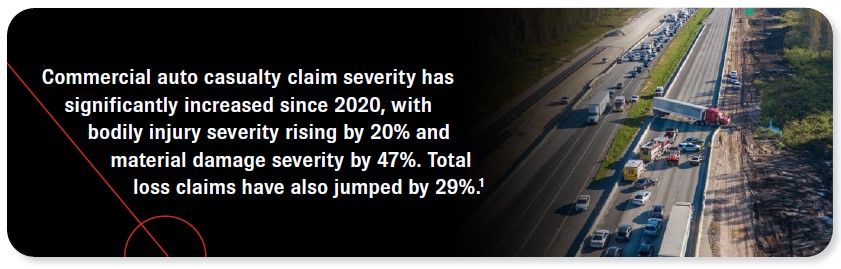
Claim severity across multiple lines of casualty business has grown to the point that excess insurers have been raising rates, reducing their capacity and, in some cases, exiting classes of business.2 The insurers that remain are wary about claims further eroding their profitability. As current market conditions continue to harden, insurers may take a more aggressive stance on late notification.
FOLLOW FORM? NOT SO FAST
Historically, excess insurers followed the primary form without question. However, recent market dynamics have led many carriers, particularly in property and auto, to write on their own forms and move away from blanket follow-form treatment.
Today, mid-term changes to coverage, such as adding or removing vehicles or properties, often require specific endorsements on all excess layers, not just the primary. Failing to update each layer can create dangerous coverage gaps. Even when the number or type of vehicles remains unchanged, some excess carriers now require exact identification by VIN or address to ensure coverage applies. Claims have been denied where these endorsements were missing, despite the primary policy providing coverage.
It’s also critical to confirm that the inception and termination dates of excess policies align with the primary coverage. While rare, there have been situations where excess coverage lapsed or was not renewed in time, leaving insureds exposed when a claim arose. Understanding these nuances and carefully coordinating changes across the tower is essential to maintaining seamless protection.

KNOW THE DIFFERENCE: RESERVATION OF RIGHTS VS. DENIAL
Insurers unsure about a claim may issue a Reservation of Rights (ROR) letter, which preserves their right to investigate or limit coverage without waiving it.
Unlike a denial, which ends involvement, an ROR keeps insurers engaged and can lead to partial contributions toward settlement. That’s a key reason brokers often advocate for RORs in gray areas. Although many insureds might view them as nearly the same, they are quite different.
Insurance carriers have a legal obligation to promptly determine if there is coverage and advise the insured so that the insured can manage and resolve the claim, with or without the insurer’s involvement. If an insurer does not assert its coverage position on a claim, it may be presumed to have waived its right to do so. With a coverage denial, the insurer gives up any control it might have had over the claim.
With a ROR, on the other hand, the insurer can maintain control of the claim. The ROR is a short-term mechanism to avoid waiving the right to assert a coverage position while the insurer investigates the facts surrounding the claim. RORs are a formal way of asserting the insurer may limit, or even deny, coverage pending further investigation, or perhaps even defense, of the claim.
RORs can benefit both insurers and insureds. Insurance companies may use the ROR to negotiate a reduced contribution. By the same token, brokers often push carriers to issue RORs so insureds can seek contributions to settling the claim. A coverage denial removes the possibility of an insurer contributing to a settlement, while the ROR leaves open that possibility. In nearly all cases, even after issuing a Reservation of Rights, insurers have contributed to settlements.

COURT VIEWS ON LATE NOTICE
Courts across the United States have issued mixed rulings on late notice of claims and whether the burden of proof rests with insurers or insureds. If there is any common thread in insurance coverage case law, it’s that courts generally do not like to see insurers deny coverage.
The argument over late notification hinges on the issue of whether the delay prejudiced the insurer’s actions. In other words, if the insurer had timely notice, could it have taken actions to minimize the insured’s liability? A federal court in Texas examined several different cases in creating a three-factor test for determining whether an insurer was prejudiced by late notice:
- What rights did the insurer have under the policy and were those rights lost by the insured’s untimely notice?
- Did the insurer produce evidence that it would have exercised those rights?
- Did the insurer demonstrate as fact that its actions would have affected the outcome of the lawsuit?
Such a test sets a relatively high bar for insurers to prove that late notification of claims prejudiced them. But it’s important to note that courts generally apply this reasoning to occurrence policy forms, not to claims-made or claims-made-and-reported policies. The reason is straightforward: Claims-made policy forms typically require that notification occur during the policy period, or a specified number of days after expiration, such as an extended reporting period. Occurrence forms, on the other hand, may respond to claims filed outside of the policy period.
Regardless of the policy form, it’s obviously better for insureds to have coverage than not. For this reason, insurance laws traditionally have considered the duty to defend as broader than the duty to indemnify insureds.

PRACTICAL TIPS FOR POLICYHOLDERS
Even though a longstanding principle in insurance law is to construe ambiguity in favor of the insured, policyholders should consider the following tips.
Do take the time to understand your policy. Every policy is a legally binding contract, and insureds should know what their responsibilities are.
Do talk with your insurers before you experience a claim. Many coverage disputes could be avoided if insurers and insureds established clear communications and expectations before a claim is ever filed. Some insurers like to hear about every claim no matter how small, while others only want to know about those claims that might exceed a certain threshold.
Do consult with specialists. Whenever you become aware of an incident that could generate a claim, it’s prudent to discuss the situation with specialists in law and insurance. A rule of thumb is to notify insurers if a claim reaches 50% or more of the deductible or self-insured retention.
Don’t unreasonably delay notification. A reasonable amount of time straddles the extremes of immediate notification after an event and delivering notice on the courthouse steps. Insureds should not wait to notify their insurers. Timely notice can enable insurers to assist in mitigating the claim and preparing a strong defense.
Don’t expect excess insurers to follow the primary form. Historically, excess insurers used to follow the form of the primary coverage, including its terms and conditions. Now, excess insurers are more likely to follow their own forms, which may differ significantly from the underlying layers.
Don’t view RORs as equivalent to coverage denials. Excess insurers may issue RORs to preserve their ability to contribute a lesser amount to settle a claim based upon the existence of coverage issues, but will typically still contribute to any settlement that reaches their layer of coverage.
BOTTOM LINE
Excess insurers are more cautious and more selective in today’s challenging market. Late claim notice, especially without documenting midterm policy changes, can mean the difference between coverage and a costly denial. The best defense is a proactive one: involve your wholesale broker early, document everything, and don’t assume follow form applies. Reach out to your CRC Specialty Producer today for assistance.
CONTRIBUTORS
- David Gilfillan leads CRC Group’s Claims Advocacy Team, offering guidance on complex claims issues, carrier engagement, and risk mitigation strategies across casualty lines.
END NOTES
- Auto Claims Severity Up Significantly Since 2020 With No Sign of Slowing, Big I, June 20, 2024. https://www.iamagazine.com/news/auto-claims-severity-up-significantly-since-2020-with-no-sign-of-slowing#:~:text=Bodily%20injury%20severity%20has%20risen%2020%%20from,all%20material%20damage%20coverages%20has%20increased%2047%.&text=Further%2C%20total%20loss%20claims%20have%20increased%2029%,collision%20claims%20in%202023%20deemed%20total%20losses.
- 2025 Casualty State of the Market at a Glance, CRC Group. March 2025. https://www.crcgroup.com/Portals/34/SOTM/2025%20Casualty%20State%20of%20the%20Market%20at%20a%20Glance.pdf