Recent shifts in Environmental Protection Agency (EPA) priorities are reshaping the regulatory landscape in ways that directly impact environmental risk and casualty insurance. Since 2025, the EPA has initiated a broad deregulatory agenda, rolling back or reconsidering dozens of rules while reducing enforcement activity and shifting more authority to the states.
While the stated goal is to reduce costs and regulatory burden, the underlying legal framework has not changed. Environmental liability remains strict, joint and several, and long-tail in nature.
For retail agents, the implication is clear: less regulation does not mean less risk. It often means fewer guardrails, delayed detection, and greater loss severity when contamination is ultimately discovered. Understanding this dynamic is critical to properly advising clients in today’s marketplace.
Regulatory Guardrails vs. Legal Liability
Federal environmental laws, such as CERCLA (Comprehensive Environmental Response, Compensation, and Liability Act), impose strict joint and several liability on responsible parties.1 Often described as “cradle to grave” responsibility, this framework allows regulators, or private plaintiffs, to pursue any potentially responsible party for the full cost of remediation, regardless of fault allocation.
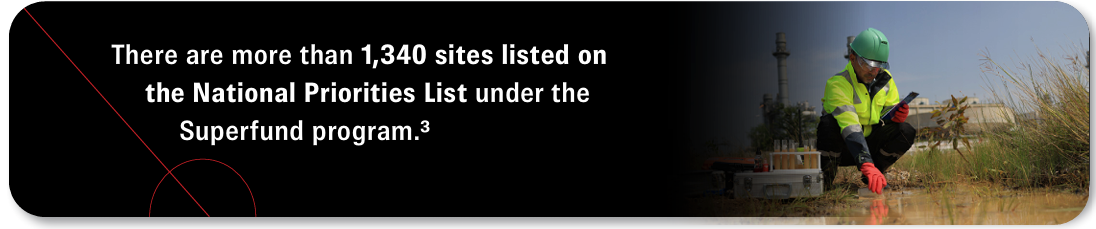
Even if enforcement activity fluctuates, the underlying statutory liability remains intact. According to the EPA, more than 450,000 brownfields and contaminated sites exist in the United States.2 Additionally, as of 2024, there were over 1,340 sites listed on the National Priorities List under the Superfund program.3 These legacy exposures illustrate how environmental risk persists across decades.
When regulatory guardrails are removed or reduced, so are early warning systems. Inspections, reporting requirements, and compliance triggers often identify contamination early, before it escalates into severe remediation costs or bodily injury claims. Without those mechanisms, contamination may go undetected longer, increasing ultimate loss severity.

The Myth of “Less Regulation = Less Risk”
Environmental laws are strict liability laws. A change in reporting requirements or inspection frequency does not change a client’s environmental exposure.
In fact, when enforcement activity declines, neighboring property owners and downstream third parties may rely less on regulatory intervention and instead pursue direct legal action. Citizen suits are expressly permitted under many federal environmental statutes.4 In other words, enforcement does not disappear. It shifts from regulators to private plaintiffs.
That shift can create more unpredictable litigation and defense costs, particularly when coverage under standard commercial general liability (CGL) and property policies is denied due to pollution exclusions.
The Pollution Exclusion Problem
The “Absolute” Pollution Exclusion was introduced into ISO CGL forms in 1986 and remains largely intact today.5 This exclusion evolved into what we commonly see today, which is the Total Pollution Exclusion which eliminates the givebacks the “Absolute” Pollution Exclusion provided. Most standard CGL and property policies exclude coverage for bodily injury or property damage arising out of the discharge, dispersal, release, or escape of pollutants.
Over time, new contaminants of concern, including PFAS (per- and polyfluoroalkyl substances), mold, asbestos, and silt and sediment, have increasingly fallen within pollution exclusion interpretations. This has led to specific contaminant exclusions in addition to the pollution exclusion to further clarify the markets’ intent not to provide coverage. PFAS alone has triggered widespread litigation; approximately 15,000 PFAS-related lawsuits are pending nationwide.6
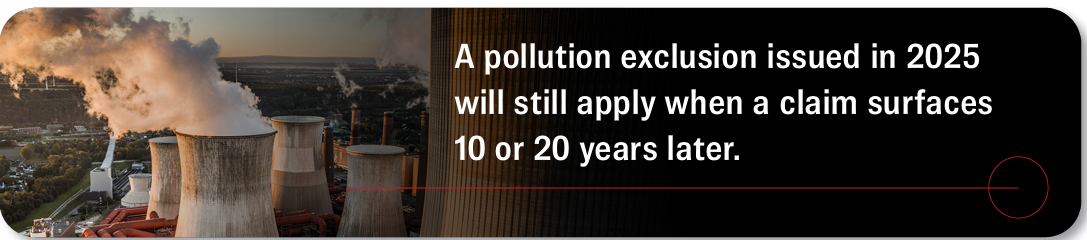
Yet many insureds mistakenly assume that because regulatory oversight appears lighter, their environmental exposure has lessened. The policy language has not changed. A pollution exclusion on a CGL policy issued in 2025 will still apply when a claim surfaces 10 or 20 years later.
Long-Tail Exposures Do Not Expire
Environmental claims are notoriously long-tail. Contamination events may occur years before bodily injury or property damage becomes apparent.
According to data compiled by the Government Accountability Office, cleanup timelines for complex contaminated sites often span decades.7 With lax oversight, detection can be further delayed, compounding loss severity.
Standalone pollution legal liability (PLL) policies are specifically designed to address these discovery lag exposures for property owners and operators. They provide coverage for gradual pollution conditions, third-party bodily injury and property damage, cleanup costs, and can often include defense costs outside the limits of liability, something a CGL policy will not provide once the pollution exclusion is triggered.
Faster Permitting Can Mean More Risk
Another key development tied to deregulation is streamlined permitting. Faster approvals can accelerate infrastructure, energy, and construction projects that historically would require lengthy environmental review.
On its face, this supports economic growth. But compressed timelines can also create or exacerbate environmental conditions of concern, with less documentation available to identify potentially responsible parties.
Where projects once underwent multi-year environmental impact assessments, some may now break ground in months. The faster construction cycle increases the importance of proper project pollution liability (PPL) and contractors’ pollution liability (CPL).
Without clear environmental insurance structures, disputes over responsibility in a pollution event can delay cleanup and intensify litigation - again increasing loss cost severity.
Public Pressure + Insurability
As regulatory oversight shifts, exposure does not disappear. It often moves elsewhere. Even during periods of reduced enforcement, community groups and private citizens can rely on longstanding federal statutes such as the Clean Water Act, Clean Air Act, and CERCLA to pursue legal action. These laws impose strict, joint and several liability, allowing claims to be brought regardless of regulatory activity.
In this environment, environmental insurance is a critical risk transfer tool. It helps protect insureds from pollution-related claims that can arise independent of regulatory scrutiny, particularly when enforcement visibility is reduced but legal liability remains fully intact.
The environmental insurance marketplace effectively performs its own underwriting diligence. If a business is uninsurable on pollution grounds, that signals underlying operational risk. In this sense, environmental insurance serves as both financial protection and risk discipline.
Deregulation should not be viewed as permission to self-insure a commonly excluded cause of loss. In fact, it broadens the gap between covered and uncovered exposures under traditional policies.

What Retail Agents Should Be Asking
For retail agents, this is an opportunity to reframe the environmental conversation:
- Does your client store, transport, or dispose of hazardous materials?
- Are they acquiring property with potential historical contamination?
- Are they accelerating development under faster permitting timelines?
- Do they rely solely on CGL and Property policies with absolute pollution exclusions?
Environmental risk is not confined to traditional “industrial” accounts. Real estate owners, contractors, manufacturers, municipalities, healthcare facilities, and habitational risks all face potential pollution exposures.
The EPA’s step back does not reduce the pollution risk for your clients. It transfers that risk entirely from the regulatory system onto their balance sheet.
Bottom Line
Less regulation does not mean less environmental liability. It often means fewer warning signs, more private litigation, and greater severity when contamination is discovered.
Absolute and total pollution exclusions remain embedded in most standard CGL and Property policies. Long-tail contamination claims have no expiration date. Faster permitting can mean faster exposure. And strict, joint and several environmental liability still applies - cradle to grave.
CRC Specialty’s Environmental brokers work exclusively in this space. We understand the policy language, evolving contaminants, regulatory shifts, and the nuances between PLL, CPL, and project pollution.
When regulatory oversight changes, environmental risk does not disappear. It becomes more complex. Team CRC is your go-to partner to help retail agents identify, structure, and place the right environmental coverage before a claim surfaces years down the road. Reach out today.
Contributors
- Harrison Scheider is a Senior Vice President and Environmental Broker with CRC Group, specializing in complex environmental risk placements across real estate, construction, energy, and industrial sectors.
- Dustin Helmenstine is an Environmental Broker with CRC Group, focused on developing customized pollution risk solutions for retail agents and their clients.
Endnotes
- Superfund: CERCLA Overview and Liability, U.S. Environmental Protection Agency, September 6, 2023. https://www.epa.gov/superfund/superfund-cercla-overview
- Brownfields Overview and Statistics, U.S. Environmental Protection Agency, October 17, 2023. https://www.epa.gov/brownfields
- National Priorities List, U.S. Environmental Protection Agency, November 2024. https://www.epa.gov/superfund/national-priorities-list-npl
- Citizen Suits and Environmental Enforcement, U.S. Environmental Protection Agency, July 24, 2023. https://www.epa.gov/enforcement/citizen-suits
- 1986 Commercial General Liability Coverage Form Revision (CG 00 01), Insurance Services Office (ISO), industry standard form revision widely referenced in IRMI and insurance coverage literature.
- 2025 Updated Primer On PFAS/Forever Chemical Claims Regulation, Litigation, & Insurance Coverage Issues, JD Supra, December 2025. https://www.jdsupra.com/legalnews/2025-updated-primer-on-pfas-forever-6031988/
- Superfund Program: EPA’s Progress and Challenges, U.S. Government Accountability Office, July 2021. https://www.gao.gov/products/gao-21-555